



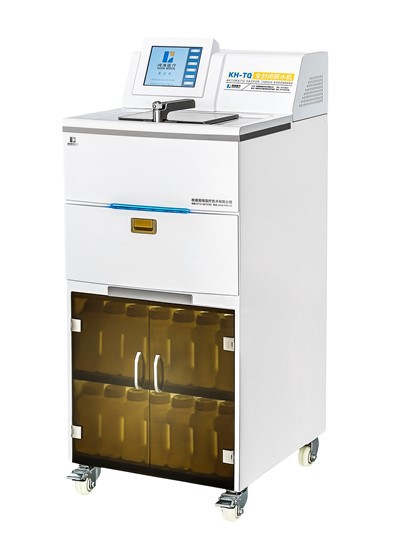
Tissue Processor
Your Professional Tissue Processor Supplier
We are your professional Tissue Processor manufacturer, in 2015, Kuohai was recognized as a "national high-tech enterprise". "Kuohai Medical Technology" has five subsidiaries, including Hubei Xiaogan Kuohai Medical Technology Co., Ltd., Xiaogan Kuohai Medical Technology Co., Ltd., Hubei Haishi Industrial Co., Ltd., Xiaogan Ruifeng Electronic Technology Co., Ltd., Xiaogan Dinghang Decoration Engineering Co., Ltd., and its product range covers medical equipment, biotechnology, electronic technology, high-end building materials, decoration engineering and other industries.
Why Choose Us
Our company
Xiaogan Kuohai Medical Technology Co.,Ltd. is a rare domestic pathology instrument manufacturing company with a widespread user base throughout China. It is also one of the few companies in the domestic and international industry capable of researching, developing, and producing a complete set of pathology instruments and consumables. In 2014, the company established a modern production and processing base.
Our services
All our equipment will be equipped with very detailed instructions, so that your operation is simple and straightforward, and no questions arise. At kuohai medical technology, we guarantee the quality and durability of our products.
Our products
The product range involves medical equipment, biotechnology, electronic technology, high-end building materials, decoration engineering and other industries.



Key Steps in Histological Tissue Processing
Fixation
Formalin fixation stabilizes the three-dimensional structure of tissues by cross-linking proteins. Without fixation, tissues would undergo autolysis, a process where endogenous enzymes within the cells start breaking down cellular components. Additionally, the risk of putrefaction increases, leading to bacterial decomposition of tissues.
Formalin fixation arrests these processes, allowing researchers to study tissues in a state that closely resembles in vivo conditions.
Dehydration
The removal of all free water is crucial for embedding in nonaqueous medium such as paraffin or celloidin. Gradual dehydration with a series of alcohol solutions is important for successful processing. If the dehydration step is incomplete, the tissue will be soft and mushy. This will cause the subsequent steps to improperly achieve what they are intended for. Dehydration steps are generally where issues with processing lie. Overhydration is also a concern because molecular bound water needs to keep the cellular shape and the tissue will be brittle and difficult to work with.
Clearing
To enhance transparency, the tissue is run through multiple rounds of a clearing reagent, which replaces the dehydrated alcohol. Clearing is vital for optimal visualization under a microscope because it makes the tissue receptive to infiltration. It is very important to choose a clearing agent that is miscible with the infiltration medium.
Infiltration and embedding
Tissues are infiltrated with a supporting medium like paraffin wax, creating a solid block. During embedding, the orientation at which the tissue is placed in the paraffin is also important. At any given angle, different structures will be shown depending on what is being looked for.
Sectioning
Precision is paramount during sectioning, as thin slices enable detailed microscopic examination. Modern techniques, like microtomy, ensure consistency in section thickness.
Staining
Staining provides contrast, highlighting specific cellular structures or molecules. Hematoxylin and eosin (h&e) staining is a classic method, but specialized stains May be employed based on research objectives.
Histological examination
The primary use of an automatic tissue processor is in histopathology, where it plays a pivotal role in the preparation of tissue samples for microscopic analysis. It is essential for diagnosing various medical conditions, such as cancer, infectious diseases, and autoimmune disorders.
Research
In biomedical and life sciences research, automatic tissue processors are used to prepare tissue samples for various studies, including molecular biology, genetics, and cell biology. Researchers can analyze tissue structures and components to understand diseases and develop new treatments.
Quality control
Tissue processors help maintain the consistency and quality of tissue preparation, reducing the risk of errors in clinical and research settings. Standardized processing ensures that the results are accurate and reliable.
Education
They are used in educational institutions and medical schools to teach students about tissue processing and histological techniques.
Biobanking
Automatic tissue processors are used in biobanks for the long-term preservation of tissue samples for future research and clinical applications.
Control panel
The control panel allows the user to set and monitor processing parameters such as temperature, agitation, and processing time. It provides a user-friendly interface for programming and adjusting processing protocols.
Processing chamber
The processing chamber is where the tissue specimens are placed. It is designed to hold various sizes and types of cassettes or containers, ensuring proper immersion in the processing reagents. The chamber should be resistant to chemical damage and easy to clean.
Reagent containers and dispensers
Tissue processors have separate containers for each processing reagent, including fixatives, dehydrants, clearing agents, and embedding media. These containers are equipped with automatic dispensing mechanisms to ensure proper and consistent reagent delivery to the specimens.
Temperature control system
Tissue processors have a temperature control system that maintains the desired processing temperature throughout the entire processing cycle. This ensures optimal tissue preservation and processing outcomes.


Agitation mechanism
An agitation mechanism ensures thorough and uniform mixing of the specimens with the processing reagents. It can be in the form of oscillation, rocking, or rotation, depending on the specific tissue processor model.
Fluid circulation system
A fluid circulation system facilitates the movement and exchange of processing reagents within the processing chamber, promoting consistent and efficient tissue processing.
Safety features
Tissue processors should have safety features such as alarms, temperature monitoring, and emergency shut-off mechanisms to protect the specimens, operator, and instrument from potential risks or malfunctions.
Drying system
Some tissue processors also have a built-in drying system to aid in the removal of residual fluids from the processed tissues before embedding.
Programmable protocols
Tissue processors allow the user to program and store custom processing protocols for different types of specimens. This ensures optimal processing conditions and flexibility in adapting to specific requirements.
Specification of Tissue Processor
|
Power supply |
220V±10%, 50Hz / 110V±10%, 60Hz |
|
Fuse |
220V:5AUPS:2A/110V:8A UPS:3A |
|
Power |
466W |
|
Outside dimensions(mm) |
1235X475×590(W*D*H) |
|
Weight |
70 kgs |
Certificate


FAQ
Xiaogan Kuohai Medical Technology Co., Ltd. is one of the leading tissue processor manufacturers and suppliers in China. We warmly welcome you to buy cost-efficient tissue processor for sale here from our factory. All customized products are with high quality and competitive price. Contact us for OEM service.
Tissue Processor Machine, Tissue Processor Histology, Tissue Processor