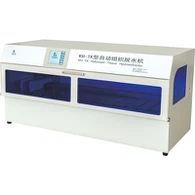


(1) 10 inch TFT true color LCD touch screen operation
(2) Fully enclosed, vacuum operation, no pollution, no carcinogenic formaldehyde, xylene and other harmful gases leakage
(3) Intelligent anomaly monitoring and protection system, imported double high-speed CPU
(4) Remote alarm function for the doctor to monitor no matter when and where
(5) Self-test function, self-diagnose the fault
(6) Fully enclosed air pressure stirring, increasing the penetration of reagents to cells to achieve excellent effect
(7) Cleaning reagent replacement reminder, automatically monitor the purity of the reagent to ensure the dehydration effect and reduce the consumption
(8) Negative pressure strong suction specimen residual reagents, to avoid reagent string liquid
(9) Perfect power failure protection system to avoid the impact of power failure
Technical Data
| Type | Vacuum Tissue Processor |
| Model number | KH-TE |
| Brand name | Kuohai |
| Place of origin | China |
| Instrument classification | Class I |
| Warranty | 1 year |
| After-sale service | Online technical support |
| Hanging basket filtrate time | Optional |
| Treatment cylinder volume | 5L |
| Number of paraffin cylinder | 4 |
| Paraffin cylinder volume: | 5L |
| Treatment room temperature | Adjustable from room temperature to 85°C |
| Paraffin cylinder temperature | Adjustable from room temperature to 85°C |
| Maximum single processing standard tissue cassette | 300 |
| Working air pressure | ± 70KPA |
| Stirring time | 30 seconds |
| Stirring interval: | 5 minutes |
| Power supply | 220V±10% 50HZ |
| Power | ≤1500VA |
| Size | 650*653*1500mm |
| Gross weight | 231Kg |
Product packing and shipping details
(1) Before the product leaves the factory, our company will strictly inspect and debug all components of the machine and equipment, and test whether the equipment can be used and installed normally.
(2) In order to prevent the product from being squeezed and damaged during long-distance transportation, we will use thick foam to fix the four corners of the product, and use standard export wooden boxes for external packaging.
(3) If you need OEM and ODM services and have separate product packaging solutions and logo printing standards, please communicate your plans and standards with us in advance. We can package the product according to your requirements.
(4) Transportation methods: a combination of sea, land, railway, air, and express delivery.
FAQ

What is the aim of tissue processing?
The aim of tissue processing is to prepare biological tissue samples for microscopic examination, allowing researchers, pathologists, and medical professionals to study the cellular structure and composition of tissues. Tissue processing is a critical step in histology and pathology, and its primary objectives include:
Preservation of Tissue Structure:
Tissue processing involves fixation, where tissues are treated with a fixative (often formalin) to preserve the structure of cells and prevent decay. This step ensures that the tissues maintain their original morphology for microscopic analysis.
Removal of Water:
Dehydration is a key step in tissue processing, where water is gradually replaced with alcohol. This removes water from the tissues, making them more compatible with embedding media that are not miscible with water.
Transparency of Tissues:
The clearing step involves treating tissues with a substance like xylene to remove the alcohol. This process enhances the transparency of tissues, allowing for better penetration of embedding media and facilitating subsequent sectioning.
Embedding in a Supportive Medium:
Infiltration involves impregnating tissues with a liquid embedding medium, commonly paraffin wax. This step provides structural support to the tissues, allowing them to be sectioned into thin slices without distortion.
Facilitation of Sectioning:
The processed tissue blocks can be sectioned using a microtome to obtain thin slices. These thin sections are then mounted on slides for staining and microscopic examination.
Enhancement of Microscopic Observations:
Tissue processing sets the stage for various staining techniques that highlight specific cellular components, such as nuclei, cytoplasm, and extracellular structures. Stained tissue sections can be observed under a microscope to study tissue architecture, identify abnormalities, and aid in the diagnosis of diseases.
In summary, the aim of tissue processing is to systematically prepare biological tissues for microscopic analysis by preserving their structure, removing water, enhancing transparency, providing structural support, and facilitating sectioning and staining. This process is crucial for both diagnostic pathology and research in fields such as biology and medicine.
Hot Tags: enclosed tissue processor, China enclosed tissue processor manufacturers, suppliers, factory, Tissue Processor Machine, Automated Tissue Processor, Tissue Processor, Rapid Tissue Processor, Automatic Tissue Processor, Enclosed Tissue Processor