



Tissue Embedding Center
Xiaogan Kuohai Medical Technology Co.,Ltd
Xiaogan Kuohai Medical Technology Co.,Ltd. is a rare domestic pathology instrument manufacturing company with a widespread user base throughout China. It is also one of the few companies in the domestic and international industry capable of researching, developing, and producing a complete set of pathology instruments and consumables. In 2014, the company established a modern production and processing base.
Why Choose Us
Rich Experience
Xiaogan Kuohai Medical Technology Co., Ltd. is a rare domestic pathology instrument manufacturing company with a widespread user base throughout China.
High Quality
The product range covers industries such as medical instruments, biotechnology, electronic technology, high-end building materials, and decoration engineering.
Technical Support
Our team of experts is available to assist with troubleshooting, answer technical inquiries, and provide guidance.
Customer Service
We prioritize open communication to address our clients' specific requirements and deliver personalized solutions.


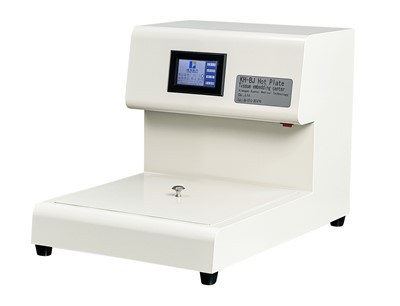


A tissue embedder is a device that prepares samples for research applications by surrounding tissue with a supporting material to protect it during further processing. The process of surrounding tissue with a supporting material is called tissue embedding.
How to Submit Tissues for Embedding
Tissues can be accepted in a variety of ways and costs are tailored to these methods.
Fresh tissue: If fresh tissue is submitted, it will be placed in 10% Neutral Buffered Formalin for fixation overnight prior to processing.
Fixed tissue: We accept tissue which has been fixed in a variety of fixatives. Once fixation is complete, please transfer samples to 70% Ethanol.
Fixed tissue in Cassettes: Customers are welcome to place their tissues in cassettes to ensure desired orientation.
The following are available to our customers for use and are available for pick-up in E1515:
10% Neutral Buffered Formalin (NBF)
Cassettes (for a fee)
Biopsy wraps/cassettes
Fix tissue as desired: Allow ~1 mm/hour for the fixative to penetrate your tissues and a volume of 10-20 times fixative volume to tissue.
Label cassettes: When labelling cassettes, use only a reagent resistive marker (ex: Statmark Pen) or a #2 hard lead pencil for cassettes, never a pen or Sharpie marker. Solvents used in processing can remove the ink from many "permanent" Sharpie markers.
Ensure small pieces will not be lost: To prevent small tissues from being lost during processing, place in biopsy cassettes or wrap in filter paper. The tissue processor uses vacuum to facilitate infiltration which can remove tissue from the cassette.
Place in cassettes in desired orientation: When tissue is placed into cassettes the tissue surface that is place down in the cassette will be placed down for embedding and this is the surface that is sectioned first. Please list any special embedding requests on submission form.
Refrain from overcrowding. Tissue that is compressed in the cassette will not adequately fix, infiltrate, section, or stain.
Specimens should be cut thin enough to allow adequate fixative penetration.
Do not allow tissue to touch all sides of the cassette or become smashed in the lid.
The thickness between 0.2 and 0.5 cm (approximately the size of a nickel) is a good guide to use when trimming samples.
If batches of tissues are being submitted at the same time that vary significantly in size (whole organs vs biopsy samples), sort by size and submit in separate cassettes.
Place specimens in spill roof container with a tight fitting lid. Be sure that all tissue and or cassettes are completely submerged in 70% Ethanol so samples do not dry out.
Label the transport container: Please include the name of the PI, name of the Researcher (submitter), solution, and date.
Provide samples and submission form to RHS. A separate sheet is also provided to list the specimen identification.
Tissue already in Paraffin Blocks or blank slides from paraffin blocks are gladly accepted for sectioning and staining.
Tissues can be accepted in a variety of ways and costs are tailored to these methods.
Rapid rather than slowly freezing reduces ice crystal formation in tissue.
Fresh tissue: If fresh tissue is submitted, rapidly frozen without fixation.
Fixed tissue: We accept tissue which has been fixed in a variety of fixatives. Some customers choose to prepare their samples through a sucrose gradient prior to freezing. Once tissue is prepared, please transfer samples to 30% sucrose prior to delivery to RHS.
Frozen blocks in OCT molds: Customers are welcome to freeze their own samples to ensure desired orientation. Frozen blocks can then be provided to RHS for sectioning/further processing.
A pre-labeled tissue mold is filled one third full with OCT embedding compound.
Tissue should be gently blotted free of extraneous fluid prior to being frozen.
Tissue specimen is oriented in tissue mold (clearance between the edge of tissue and side of mold should be maintained)
The remainder of tissue mold is filled with OCT embedding medium. Ensure that specimen is completely surrounded and covered by OCT.
Tissue mold is floated on liquid nitrogen bath until completely frozen. OCT will be firm and opaque/white.
Remove mold from liquid nitrogen and tightly wrap in foil.
Place foil wrapped specimen in plastic bag that is properly labeled with specimen identification and date. Please include the name of the PI, name of the Researcher (submitter), solution, and date.
Tissue should be stored at -80 C and delivered to RHS on dry ice.
Provide samples and submission form to RHS. A separate sheet is also provided to list the specimen identification.
Tissue Embedding Throwdown: Paraffin vs OCT vs Resin
Tissue embedding and sectioning is a backbone of many biological research labs. While commiserating with other grad students over tedious hours spent in the lab, you're probably aware that there is more than one way to slice up a chunk of tissue. We've previously introduced what to consider when choosing a tissue embedding medium and discussed some alternatives to paraffin embedding, the most common embedding medium. But if you are still wondering if one technique is better than another, or what it would take to start using a new sectioning method, keep reading. We'll cover that here.
The three primary means of embedding tissue for sectioning are paraffin wax, Optimal Cutting Temperature (OCT), and resin. Each has its own set of pros and cons. Which tissue embedding medium to use really comes down to how you plan to use your embedded tissue. Some of the uses overlap, so check out the chart below to see how they differ and what to expect with each technique.
|
Paraffin |
OCT |
Resin |
|
|
Uses |
Light microscopy |
Light microscopy, western blot |
Electron microscopy |
|
Tissue preservation |
Perfusion or immersion fixation in 4% paraformaldehyde |
Snap freezing |
Perfusion or immersion fixation in 4% glutaraldehyde; |
|
Equipment and unique supplies |
• Microtome ($10–30K) |
• Cryostat microtome ($15–50K) |
• Ultramicrotome ($50–70K) |
|
Preparation time |
2 days |
< 1 day |
3 days |
|
Standard section thickness |
4–5 µm |
1–100 µm |
< 1 µm |
|
Storage |
Dry on glass slides |
Fresh in -80°C freezer or |
Electron microscope grids at RT |
|
Antigen Masking |
Medium |
Low |
High |
|
Pros |
• Versatile |
• Doesn’t require fixed tissue |
• Ultra-thin sectioning |
|
Cons |
• Difficult to produce thinner sections |
• Delicate sections |
• Expensive equipment |
Major equipment costs vary widely depending on the manufacturer and quality—just like buying a car, you'll pay more for all the bells and whistles. Purchasing equipment might be in store for you if your lab is embarking on a new technique that will become an experimental staple, but for the occasional experiment here and there, it probably won't be necessary. Costs can be saved collaborating with labs that already own the equipment or by making use of university research core centers.
Many scientists have their own favorite sectioning method. But when deciding which tissue embedding method would be best for you, make sure you choose the technique best suitable for how you plan to use the tissue.
Tips for Choosing an Embedder
When choosing an embedder, three areas should be considered to maximize your purchase: Simple Operation, Smooth Workflow and Precise Control.
Simple Operation
First, the instrument needs to be simple to use. This includes being easy to configure - including the temperature, scheduling and timing. A touch screen with an easy-to-use interface is also important because it offers a "one-stop shop” to configure and operate the instrument. This will allow for minimal training of staff and increased productivity.
Consider the size of the paraffin tank needed in your lab. A large tank will allow for fewer paraffin refills, less melting wait time, and allow for enhanced efficiency. In addition, ergonomic & insulated wrist pads helps provide added user comfort, and protection from the temperature of the hot plate and chill of cold plate.
Smooth workflow
A smooth workflow is all about making life easier for the user, while providing higher throughput. This includes using an instrument that is easy to maintain, but also easy to clean. Be sure the instrument uses high quality material on the workspaces because removing wax from plastic surfaces can be a difficult task. An effective scraper can help you clean and maintain the surfaces of your embedder, even for those hard to clean areas.
Customizable hot plate/cold plate set up – Consider a symmetric design that allows the instrument to be configured for left or right-handed lab personnel. This provides the additional flexibility to customize your workflow.
An automatic starter for the hot plate saves time by allowing you to program the start time based on your lab schedule. Normally, it can take 2-3 hours to heat the wax to the optimal temperature. For instance, if you plan to use the embedder at 8:30 am, the automatic start will initiate the heating process at 5:00 am, allowing you to save time and maximize efficiency in the lab. An automatic starter can also provide cost savings by only using electricity while the instrument is in use, and not during idle periods.
Precise Control
A consistent surface temperature for the hot & cold plate is critical during the embedding process. Without this temperature consistency, samples could freeze at different times, impacting quality of the sample and disrupting the workflow.
An LED light gives the operator the best view of the sample. These lights are much brighter and whiter than previous bulb types, providing better visibility during sample handling. Traditional lights can create a yellow tint that can change the color of the tissue. A pure white LED light provides a more natural and realistic representation of the tissue color.
Our Factory
In 2015, Kuohai was recognized as a "National High-Tech Enterprise." "Kuohai Medical Technology" owns five subsidiaries, including Hubei Xiaogan Kuohai Medical Technology Co., Ltd., Xiaogan Kuohai Medical Technology Co., Ltd., Hubei Haishi Industrial Co., Ltd., Xiaogan Ruifeng Electronic Technology Co., Ltd., and Xiaogan Dinghang Decoration Engineering Co., Ltd. The product range covers industries such as medical instruments, biotechnology, electronic technology, high-end building materials, and decoration engineering. The company is steadily moving towards industrial group development.


FAQ
Xiaogan Kuohai Medical Technology Co., Ltd. is one of the leading tissue embedding center manufacturers and suppliers in China. We warmly welcome you to buy cost-efficient tissue embedding center for sale here from our factory. All customized products are with high quality and competitive price. Contact us for OEM service.
Tissue Embedder, Embedding Center, Tissue Embedding Center