


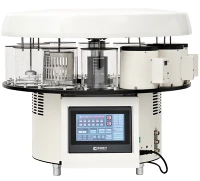



Staining resolution is a critical concept when it comes to slide stainers, which are essential tools in many fields such as histology, pathology, and microbiology. As a slide stainer supplier, understanding and communicating the staining resolution of our products is of utmost importance. In this blog post, we will delve into what staining resolution is, its significance, and how it relates to the performance of our slide stainers.
Defining Staining Resolution
Staining resolution refers to the ability of a slide stainer to achieve clear, distinct, and accurate staining of biological specimens on slides. It encompasses several aspects, including the precision of dye application, the uniformity of staining across the slide, and the ability to distinguish subtle differences in staining intensity. A high - staining resolution means that individual cells, tissues, or microorganisms can be clearly visualized under a microscope, with distinct morphological features and accurate representation of their internal structures.
For example, in histological staining, a high - resolution slide stainer can accurately stain different types of cells and tissues, such as muscle fibers, nerve cells, and epithelial cells, with clear demarcation between them. In microbiological staining, it can clearly differentiate between different bacteria and fungi, allowing for accurate identification.
Importance of Staining Resolution
The importance of staining resolution cannot be overstated, especially in medical and research settings.
Diagnostic Accuracy
In pathology, accurate staining is crucial for disease diagnosis. Pathologists rely on well - stained slides to identify abnormal cells and tissues. A slide stainer with high staining resolution can ensure that cancer cells, for example, are clearly distinguishable from normal cells. This can lead to more accurate diagnoses, which in turn can guide appropriate treatment decisions.
Research Findings
In scientific research, staining resolution affects the quality of data obtained. Researchers studying cell biology, for example, need to clearly visualize cellular organelles and their interactions. A slide stainer with poor staining resolution can lead to misinterpretation of data and inaccurate research findings.
Reproducibility
High staining resolution also contributes to the reproducibility of experiments. In a laboratory setting, different operators may use the slide stainer. A high - resolution stainer can ensure that similar staining results are obtained each time, regardless of who is operating the machine. This is essential for the validation of research findings and for consistent diagnostic results.
Factors Affecting Staining Resolution in Slide Stainers
Dye Delivery System
The dye delivery system of a slide stainer plays a crucial role in staining resolution. Our Automated Slide Stainer is equipped with a precise dye delivery system. It can accurately control the amount of dye applied to the slide, ensuring uniform staining. The system is designed to prevent over - or under - staining, which can significantly affect the resolution.
Temperature and Incubation Control
Temperature and incubation time are important factors in the staining process. Different dyes and staining protocols require specific temperatures and incubation times for optimal staining. Our slide stainers, such as the Automatic Slide Stainer, have precise temperature and incubation controls. They can maintain a stable temperature throughout the staining process, which is essential for consistent and high - resolution staining.
Washing and Rinsing Mechanisms
Proper washing and rinsing are necessary to remove excess dye and prevent background staining. Our Automated Stainer has advanced washing and rinsing mechanisms that can effectively clean the slides without disturbing the stained specimens. This helps to improve the overall staining resolution by reducing background noise.
Our Slide Stainers and Staining Resolution
At our company, we take great pride in the staining resolution of our slide stainers. Our products are designed with the latest technologies to ensure the highest level of staining accuracy and clarity.


We use high - quality materials in the construction of our slide stainers, which helps to maintain the stability of the staining process. The software controlling our stainers is also regularly updated to optimize the staining parameters for different types of specimens and staining protocols.
Our R & D team conducts extensive testing and validation to ensure that each slide stainer meets the strictest quality standards. We continuously improve our products based on customer feedback and the latest research findings in the field of staining technology.
Comparison of Staining Resolution with Competitors
When compared to our competitors, our slide stainers have several advantages in terms of staining resolution. Many of our competitors' products may suffer from issues such as uneven staining, inconsistent dye application, and poor background management.
Our Automated Slide Stainer, for example, offers more precise control over the staining process. The advanced dye delivery system can accurately dispense the right amount of dye, ensuring that each slide is stained uniformly. In contrast, some competitors' machines may use less accurate dosing mechanisms, leading to variations in staining intensity across the slide.
Our temperature and incubation controls are also more precise. This helps to ensure that the staining reactions occur under optimal conditions, resulting in clearer and more accurate staining. Some competitor products may have less stable temperature control, which can cause inconsistent staining results.
Real - World Applications and Case Studies
In many real - world applications, our slide stainers have demonstrated excellent staining resolution. For example, in a large - scale pathology laboratory, our Automatic Slide Stainer was used to stain thousands of tissue samples for cancer diagnosis. The pathologists reported that the slides stained by our stainer had clear and distinct cell and tissue structures, which greatly facilitated the diagnosis process.
In a research laboratory studying cell signaling pathways, our Automated Stainer was used to stain cells for immunofluorescence. The researchers were able to clearly visualize the localization of specific proteins within the cells, which was crucial for their research findings.
Future Developments in Staining Resolution
As technology continues to advance, we are constantly exploring new ways to improve the staining resolution of our slide stainers. We are researching new dye delivery techniques, such as micro - fluidic systems, which can provide even more precise control over dye application.
We are also looking into the use of artificial intelligence and machine learning algorithms to optimize the staining process. These technologies can analyze the staining results in real - time and adjust the staining parameters accordingly, ensuring the highest possible staining resolution.
Contact Us for Purchasing
If you are interested in our slide stainers and want to learn more about their staining resolution and other features, we encourage you to contact us. Our team of experts is ready to answer your questions and provide you with detailed information about our products. We can also arrange a demonstration of our slide stainers so that you can see the high - resolution staining results for yourself. Whether you are a pathology laboratory, a research institution, or a microbiology facility, our slide stainers can meet your needs. Don't miss out on the opportunity to enhance the quality of your staining results with our state - of - the - art slide stainers.
References
- Bancroft, J. D., & Gamble, M. (2008). Theory and Practice of Histological Techniques. Churchill Livingstone.
- Kiernan, J. A. (2015). Histological and Histochemical Methods: Theory and Practice. Springer.
- Ploem, J. S., & Tanke, H. J. (1987). Practical Fluorescence Microscopy in Biology. Oxford University Press.