




Hey there! As a supplier of chemical fume hoods, I've had my fair share of people asking me, "How does a chemical fume hood work?" Well, you're in the right place 'cause I'm gonna break it down for you in a way that's easy to understand.
Let's start with the basics. A chemical fume hood is a piece of equipment that's super important in labs where they deal with all sorts of chemicals. Its main job is to protect the people working in the lab from harmful fumes, vapors, and dust that can be released when they're doing experiments or working with chemicals.
So, how does it actually do that? First off, it's all about the airflow. A chemical fume hood creates a negative pressure environment inside it. What does that mean? Well, it means that the air pressure inside the hood is lower than the air pressure outside. This causes air to flow from the outside into the hood, bringing all those harmful substances with it.
The way it creates this negative pressure is through a ventilation system. There's usually a fan at the top of the hood that sucks the air out. This air then goes through a duct system and is either filtered or released outside the building. The fan is pretty powerful and can move a lot of air. For example, a typical fume hood can move anywhere from 600 to 1200 cubic feet of air per minute.
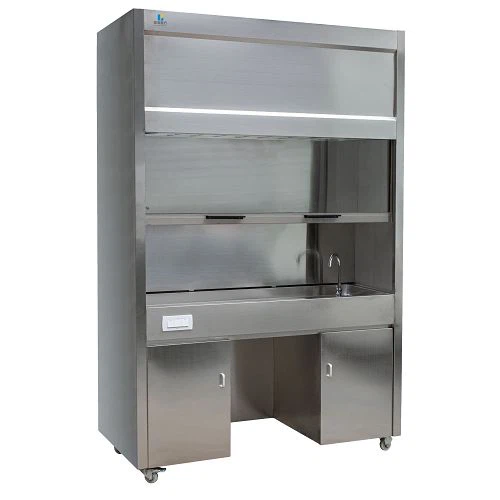
Now, let's talk about the front of the hood. You've got the sash, which is like a window. You can raise and lower it to control the amount of air that gets into the hood. When you're working in the hood, you want to keep the sash as low as possible. This helps to maintain that negative pressure and also reduces the amount of energy the fan has to use.
There are different types of chemical fume hoods, and they work a little differently. For instance, we've got the Portable Fume Hood. These are great if you need to move the hood around the lab or if you don't have a lot of space. They're smaller and more flexible, but they still work on the same principle of creating that negative pressure and sucking out the air.
Then there's the Chemistry Fume Hood. These are designed specifically for chemistry labs where they deal with all sorts of chemicals, some of which can be really dangerous. They're usually bigger and more powerful than portable fume hoods. They have better filtration systems to make sure that any harmful substances are removed from the air before it's released outside.
And of course, we can't forget about the Lab Fume Hood. This is a general term for any fume hood used in a lab. It can be a portable one or a big, fixed one. The important thing is that it does its job of protecting the people in the lab from those harmful fumes.
Inside the hood, there are also some other features that help it work better. For example, there are baffles. These are like little barriers inside the hood that help to direct the airflow. They make sure that the air moves in a smooth and even way, so that all the fumes are captured and removed.
There are also filters in the hood. These filters are really important 'cause they catch all the particles and chemicals in the air. There are different types of filters, depending on what kind of substances you're dealing with. Some filters are designed to catch dust and other solid particles, while others are designed to absorb chemicals.

Now, it's not just about the fume hood itself. You also need to make sure that it's installed and maintained properly. When it's being installed, it has to be connected to the ventilation system correctly. If it's not, then the airflow won't be right, and it won't work as well.
Regular maintenance is also crucial. You need to check the filters regularly and replace them when they're dirty. You also need to make sure that the fan is working properly and that there are no leaks in the duct system. If there are any problems, they need to be fixed right away.
So, there you have it. That's basically how a chemical fume hood works. It's all about creating that negative pressure, sucking out the air, and filtering it to make sure that the people in the lab are safe.
If you're in the market for a chemical fume hood, whether it's a portable one, a chemistry fume hood, or a general lab fume hood, we're here to help. We've got a wide range of high - quality fume hoods that are designed to meet your needs. Just get in touch with us, and we can start a conversation about what would work best for your lab.
References
- "Laboratory Ventilation Design Guide" by the American Society of Heating, Refrigerating and Air - Conditioning Engineers (ASHRAE)
- "Chemical Fume Hoods: A User's Guide" by the National Institute for Occupational Safety and Health (NIOSH)