




Xiaogan Kuohai Medical Technology Co., Ltd. is one of the most reliable manufacturers and suppliers of chemistry fume hood in China, featured by quality products and good price. If you're going to wholesale advanced chemistry fume hood made in China, welcome to get quotation from our factory. Also, customized service and 1 year warranty are available.
Company Profile
Xiaogan Kuohai Medical Technology Co.,Ltd. is a rare domestic pathology instrument manufacturing company with a widespread user base throughout China. It is also one of the few companies in the domestic and international industry capable of researching, developing, and producing a complete set of pathology instruments and consumables. In 2014, the company established a modern production and processing base.
Why Choose Us
Rich Experience
Xiaogan Kuohai Medical Technology Co., Ltd. is a rare domestic pathology instrument manufacturing company with a widespread user base throughout China.
High Quality
The product range covers industries such as medical instruments, biotechnology, electronic technology, high-end building materials, and decoration engineering.
Technical Support
Our team of experts is available to assist with troubleshooting, answer technical inquiries, and provide guidance.
Customer Service
We prioritize open communication to address our clients' specific requirements and deliver personalized solutions.

High quality SUS304 stainless steel material, corrosion-resistant, high strength, surface brushed treatment, divided into upper and lower parts!

Resistant to corrosion, acids, alkalis, and high temperatures. Various materials, such as compact laminate, epoxy resin, or ceramic, can be selected based on different experimental requirements for high-temperature or strong acid-alkali operations.

The cabinet of the fume hood can be made of materials such as steel, wood, PP, PVC, stainless steel, etc. according to usage requirements;
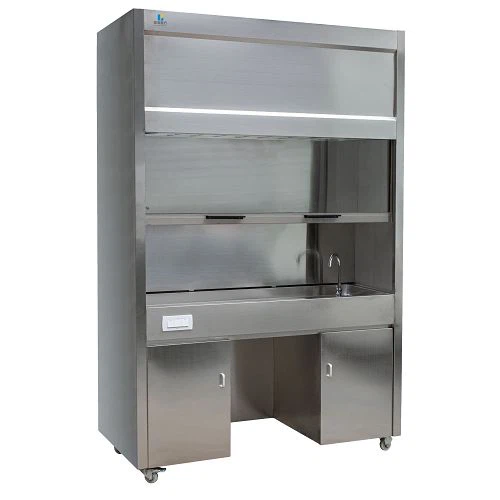
High quality SUS 304 stainless steel cabinet material, integrated cleaning pool, high-strength and corrosion-resistant, surface polished and brushed treatment;

Desk panel: Made of 1.2mm stainless steel plate with A4 stainless steel reinforcement ribs added inside.

Chemical fume hoods are equipped with a fan in the duct work that generates air flow from the front to the back of the hood. Air escapes through slots or baffles at the back of the hood. The air flow captures vapors and prevents them from diffusing into the room. Hoods are designed so that the air velocity at the plane of the sash is optimal for capturing vapors when the sash opening is no greater than the maximum operating position (for vertical opening sashes) or the test opening (for horizontal opening sashes). For vertical sliding sashes, the maximum operating height of the sash is typically 18 inches; a larger opening limits the performance of the hood. The opening should be minimized on hoods with horizontal sliding sashes and the user should work with one sash directly in front of them with their arms on either side of the sash.
Releasing
Releasing is the function of a chemistry fume hood that equips it with the ability to thin out the harmful gas emerging inside the chamber. That this air efficiently discharges outside of the chamber by means of an absorbing gas present outside.
Irreversible Function
This function enables a chemistry fume hood to prevent any discharged harmful gas from reversing back into the room from inside of the chamber. To ensure the functionality, the best way is to connect the hood with aventilation fan through a single pipe. Multiple piping will only prove suitable when used in a separate room or floor. Installing a ventilation fan at the end of the pipeline will ensure the effectiveness of the function.
Insulation
Another essential function of a practical chemistry fume hood is to provide insulation inside and outside of the hood chamber by having a sturdy glass window in front.
Wind Speed Control
Another essential function of a chemistry fume hood is to have a suitable suction speed that prevents hazardous gases from escaping from the inside. The elements that decide the suction and wind speed control are heat produced, the material used, and their properties.
Type of Chemistry Fume Hood
ADA Fume Hood
To ensure all personnel will be able to utilize facility fume hoods to the fullest, many lab designers choose ADA compliant fume hoods, which are optimized for safe and easy handling. Meticulously designed according to standards set by the Americans with Disabilities Act, ADA fume hoods include features like constant airflow, which can make working under a fume hood more comfortable for technicians using wheelchairs.
Add Air Fume Hood
Conventional fume hoods primarily utilize conditioned air pulled directly from the facility's HVAC system. Add air fume hoods collect unconditioned air from outside, reducing energy costs and creating a more efficient air-in air-out cycle. Some add air fume hoods pull as much as 70% of their air from the outdoors, seriously reducing dependence on air conditioning. This is particularly convenient in winter since no temperature regulation is needed to cool artificially warmed air.
Bench-Top Fume Hood
Bench-top fume hoods do not have their own mount or support system, and instead must be placed atop an existing work surface. Bench-top fume hoods are a great choice if you are running low on floor space but still need a full-size fume hood since this type of fume hood can simply be added to an existing workspace.
Biosafety Cabinet
In labs handling viral microbes and infectious diseases, it is vital to have an enclosed, ventilated workspace to prevent lab technicians from accidental exposure and illness. All materials that could contain viral or infectious pathogens should be examined and tested within the safety of a fume hood, which will filter and release the air to prevent harmful materials from circulating through the facility.
Canopy Fume Hood
If your lab handles smelly, but nontoxic chemicals and materials, a canopy fume hood could help to reduce foul odors. Canopy fume hoods are typically suspended or wall-mounted for easy accessibility and do not include an enclosed chamber. Canopy hoods remove fumes, steam, and smoke, eliminating harsh smells and helping to regulate temperature and humidity. Appropriate for odor reduction only, canopy fume hoods do not provide the same microbial filtration as other types of fume hoods.
Chemical Fume Hood
General chemistry and chemical fume hoods are a mainstay of virtually every research and education lab and are used to reduce the risks associated with working with common chemicals and solvents. Toxic fumes, spills, chemical reactions, and airborne droplets can be harmful to human health if inhaled or ingested, and over time, prolonged exposure can have drastic consequences. As such, lab techs always perform experiments under a chemical fume hood, which pulls fumes away from technicians and filters it, removing toxicity from the air.
What are the Procedures For Safe Use Of a Chemical Fume Hood?
For optimum safety, use all hazardous chemicals in the hood. Always perform procedures with highly toxic materials in the hood, especially those with a permissible exposure limit (PEL) of 50 ppm or less.
Perform work at least 6 inches into the hood to ensure that air is being adequately exhausted away from you and protecting you from exposure to hazardous vapors.
Keep only equipment and chemicals necessary for your experiment in the hood. When possible, raise equipment at least 2 inches off of the work surface to allow for better airflow.
Eliminate clutter in the hood. Fume hoods are not meant for storage of chemicals, lab equipment, or waste.
Keep combustibles, such as paper towels, out of the hood. Besides being a fire hazard, paper items may also become drawn into the hood exhaust system, blocking or restricting airflow.
Do not block the rear hood exhaust slots with equipment or materials. Keep items at least three inches away from back baffles.
Minimize traffic near the hood to minimize airflow disruption.
Do not position fans or air conditioners in the room in a manner that will direct air flow across the face of the hood and interfere with containment.
Never stick your head into the hood or leave the sash fully open during experiments involving hazardous materials.
Chemical fume hoods should never be used as a means of evaporating old or unwanted chemicals. Submit all chemical waste disposal requests to the Office of Environmental Health and Safety (OEHS).
Chemical fume hoods must be used according to manufacturer specifications. Some hazardous chemicals may require the use of a specialized or modified chemical fume hood (e.g. perchloric acid).
Do not modify the chemical fume hood from its manufactured settings (i.e. drilling holes into the cabinet,resetting blast gates, etc.) unless your specific modification has been assessed and approved by the RLSS. Though manufacturer specifications may change slightly from hood to hood, some basic principles are the same and must be used in University laboratories.
The majority of chemical fume hoods should be functioning at a minimum of 100 linear feet per minute (fpm), though some high performance low-flow fume hoods also exist. Often, the certification label will include a mark for the fume hood sash height at which this minimum face velocity is reached. If you are unsure if a fume hood is functioning at an adequate face velocity,contact the RLSS to perform face velocity measurements.
When a highly toxic or corrosive gas is being stored in the chemical fume hood, the face velocity should be maintained at 200 fpm.The fume hood light, alarm and sash should be fully functional at all times.
Chemical fume hoods should not be plumbed into publically owned treatment works; those with sinks should be disconnected from the drain or guarded against accidental spills.

Guidelines for Safe Use of Chemical Fume Hoods
1. Before using a chemical fume hood, become familiar with the locations of the nearest exit, emergency shower, eye-wash station, and fire extinguisher. Ensure emergency equipment remains unobstructed at all times.
2. Wear personal protective equipment (e.g. goggles, gloves, and laboratory coats). Chemical fume hoods are by no means a replacement for PPE and good laboratory practices.
3. Good housekeeping is important inside chemical fume hoods. Keep chemicals at least six inches behind the sash opening to avoid obstructing the linear flow of air.
4. Properly capped chemical containers do not need to be stored inside chemical fume hoods.
5. Opening or closing doors or windows, or a person moving quickly across in front of the chemical fume hood might create sufficient current to momentarily interrupt the linear airflow of the chemical fume, resulting in potential chemical exposure to laboratory occupants.
6. Keep the chemical fume hood uncluttered; the more cluttered a chemical fume hood, the more airflow disturbances may interfere with operation of the hood. Storage of materials/equipment in the chemical fume hood should be kept to a minimum.
7. Where open flame is used, no flammable liquids may be kept in the chemical fume hood. Flammable liquids should be stored in a cabinet or other safe location when not in immediate use.
While chemical fume hoods and biological safety cabinets may appear similar, they serve different purposes in the laboratory.
A chemical fume hood works by drawing air away from the work area and into a ventilation system that removes toxic substances before releasing it back into the laboratory or environment. Chemical fume hoods are typically used for handling hazardous chemicals, mixing and dispensing materials, and performing other chemical procedures.
On the other hand, a biological safety cabinet (BSC) is designed to provide a sterile working environment for laboratory personnel who are handling infectious microorganisms or other biological materials. A BSC works by creating a negative pressure environment that prevents microorganisms from escaping the cabinet and infecting laboratory personnel or the environment. The air inside the cabinet is filtered through a HEPA filter to remove any microorganisms before it is released into the laboratory or environment. Biological safety cabinets are typically used in microbiology, virology, and other fields that involve working with infectious agents.
While both chemical fume hoods and biological safety cabinets provide a safe working environment for laboratory personnel, they are designed for different purposes. A chemical fume hood is designed to protect personnel from hazardous chemicals and fumes, while a biological safety cabinet is designed to provide a sterile environment for working with infectious agents.

Sash: Glass window that opens and closes either vertically, horizontally, or a combination of both.
Light switch: On/off light control.
System airflow monitor and hood face velocity monitor: Device located on the outside surface of the hood to indicate airflow.
Work surface: Where work is conducted.
Sill (airfoil): Located at the bottom front of the hood to guide air smoothly into the hood and reduce turbulence.
Baffles: Moveable partitions that create slotted openings along the back wall to maintain uniform airflow across the front opening and improve containment.
Hood face: The hypothetical plane between the bottom of the sash and the work surface.
Fume hoods do not provide product protection (such as samples and specimens) from contamination. Air drawn into the hood from the room is not filtered.
Chemistry Fume Hood Maintenance Checklist
Check for type: Most Chemistry Fume Hoods fall in two categories ‒ ducted and ductless. The ducted type needs less care since it generally doesn't use filters and ducts don't require much cleaning. The ductless type uses filters a lot and they need to be changed as often as possible.
Clean up previous mess: Always clean up the mess of the previous work done in the Chemistry Fume Hood before leaving it. There will be residual film of chemicals out of the fume, there may be drops of liquid on the work surface, there may be crystal formation ‒ anything at all has to be cleaned up. Use soap and water to clean the inner surface, every inch of it.
Note: Do check if those chemicals are strongly reactive with the soap or water ‒ you don't want any surprises.
Repetitive work: Of course, if you are only going to do the exact same experiment again and again, then you may not need to clean up as often. But you do still have to do the cleanup regularly enough, and take care of the electrical equipment inside. However, if you do different kinds of work in the fume cabinet, then you need to clean it every time.
Internal wash: There are some Chemistry Fume Hoods that come with an internal washing system ‒ do make good use of it. Especially if the fumes are the heavy and settling kind. Also, if your experiment spilled or boiled over the glassware or apparatus leaked or something like that, the internal cleaning will come in extremely handy.
Check for stains: A Chemistry Fume Hood should look as good as it functions, and it should function perfectly. Wash and clean the fume cupboard till it shines like new ‒ you don't want any residue leftover of anything, not even a little soot or hard water stain.
Deep clean and light cleaning: Vary the cleaning procedure in two intensities ‒ deep clean, where you take apart much of the hood and clean every part serviceable by the user, and light clean where you just make ready the system for the next use quickly. A standard college-grade Chemistry Fume Hood can go months without the need of a deep clean. But of course, this would depend heavily on what kind of experiments you are doing in there.
Don't forget the bottom: Most Labkafe Chemistry Fume Hoods come with under-table storage options. While not as important, you should also check inside these, to see and clean anything spilled or soaked through.
Xiaogan Kuohai Medical Technology Co., Ltd. is a rare domestic pathology instrument manufacturing company with a widespread user base throughout China. It is also one of the few companies in the domestic and international industry capable of researching, developing, and producing a complete set of pathology instruments and consumables.

FAQ
Hot Tags: chemistry fume hood, China chemistry fume hood manufacturers, suppliers, factory, Laboratory Fume Hood, Chemistry Fume Hood, Lab Fume Hood, Chemical Fumb Hood, Fume Hood, Portable Fume Hood


