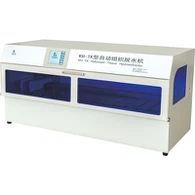


Xiaogan Kuohai Medical Technology Co., Ltd. is one of the most reliable manufacturers and suppliers of rapid tissue processor in China, featured by quality products and good price. If you're going to wholesale advanced rapid tissue processor made in China, welcome to get quotation from our factory. Also, customized service and 1 year warranty are available.
(1)High-power ultrasonic shock and precise temperature control, tissue specimens can be quickly dehydrated, transparent, wax dipping treatment.
(2)Ensure the pathologist produces an excellent section in about 25 minutes.
(3)Ultrasonic head: three ultrasonic heads, one preheating cylinder.
(4)Ultrasonic output adjustment: continuous adjustable.
(5)Time and temperature can be arbitrarily edited, real-time display of various states.
(6)Constant temperature of water bath function: make the specimen at different temperatures for constant temperature rapid treatment.
(7)Ultrasonic timing design and automatic alarm function.
(8)Fully enclosed, dust-proof, easy to clean.
Technical Data
| Type | Rapid Tissue Processor |
| Model number | KH-TB |
| Brand name | Kuohai |
| Place of origin | China |
| Instrument classification | Class I |
| Warranty | 1 year |
| After-sale service | Online technical support |
| Cylinder temperature | 1℃~100℃ |
| Ultrasonic timing time | 1~99minutes |
| Ultrasonic frequency | 0~2.4MHz adjustable |
| Maximum single processing standard tissue cassette | 3 |
| Power supply | 220V ±10﹪ 50Hz |
Product packing and shipping details
(1) Before the product leaves the factory, our company will strictly inspect and debug all components of the machine and equipment, and test whether the equipment can be used and installed normally.
(2) In order to prevent the product from being squeezed and damaged during long-distance transportation, we will use thick foam to fix the four corners of the product, and use standard export wooden boxes for external packaging.
(3) If you need OEM and ODM services and have separate product packaging solutions and logo printing standards, please communicate your plans and standards with us in advance. We can package the product according to your requirements.
(4) Transportation methods: a combination of sea, land, railway, air, and express delivery.
FAQ

What is the difference between a rapid tissue processor and a conventional tissue processor?
The differences between a "rapid tissue processor" and a "conventional tissue processor" may lie in design, performance, and application. Here are potential distinctions:
(1)Dehydration Speed:
Rapid Tissue Processor: Designed to quickly remove moisture from samples, it may utilize more efficient technologies, such as high-power microwaves or other advanced methods, to shorten dehydration times.
Conventional Tissue Processor: It might use traditional dehydration methods, potentially requiring longer durations to complete the dehydration process.
(2)Level of Automation:
Rapid Tissue Processor: Likely inclined towards automation and intelligent control to enhance operational efficiency and reduce manual intervention.
Conventional Tissue Processor: May not be as advanced in terms of automation, possibly requiring more manual operations.
(3)Scope of Application:
Rapid Tissue Processor: More suitable for scenarios requiring rapid processing of a large number of samples, such as in medical laboratories or pathology.
Conventional Tissue Processor: More versatile, applicable to various types of experiments and research.
(4)Technological Principles:
Rapid Tissue Processor: May employ novel technologies like microwave dehydration or other high-efficiency heat transfer methods.
Conventional Tissue Processor: Might use traditional heating or ventilation methods.
(5)Cost:
Rapid Tissue Processor: Potentially more expensive due to the adoption of advanced technologies.
Conventional Tissue Processor: Possibly more cost-competitive, suitable for laboratories with limited budgets.
In summary, these two types of tissue processor have distinct characteristics. The choice depends on specific experimental or application requirements, as well as the laboratory's budget and level of automation needed.
Hot Tags: rapid tissue processor, China rapid tissue processor manufacturers, suppliers, factory, Tissue Processor, Tissue Processor in Histopathology, Enclosed Tissue Processor, Automated Tissue Processor, Tissue Processor Machine, Rapid Tissue Processor