

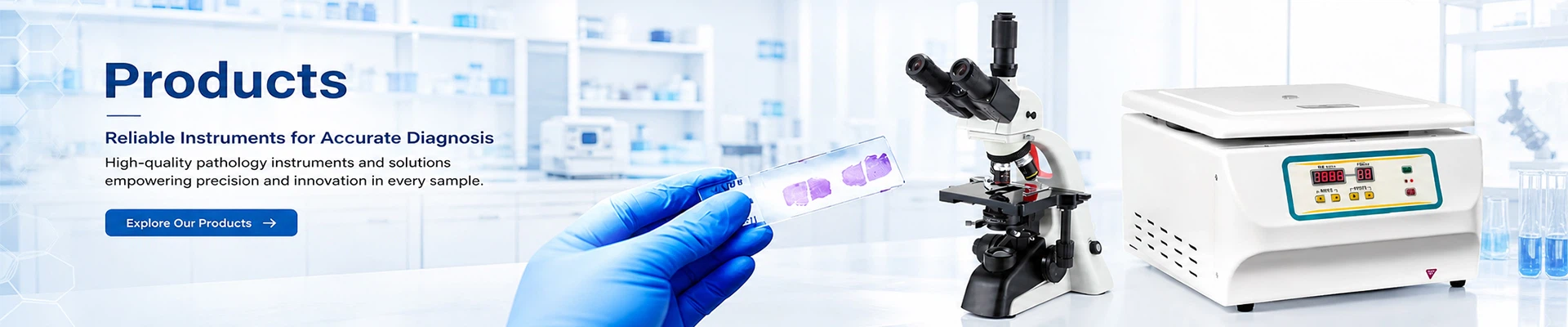


Xiaogan Kuohai Medical Technology Co., Ltd. is one of the most reliable manufacturers and suppliers of automated stainer in China, featured by quality products and good price. If you're going to wholesale advanced automated stainer made in China, welcome to get quotation from our factory. Also, customized service and 1 year warranty are available.
Company Profile
Xiaogan Kuohai Medical Technology Co.,Ltd. is a rare domestic pathology instrument manufacturing company with a widespread user base throughout China. It is also one of the few companies in the domestic and international industry capable of researching, developing, and producing a complete set of pathology instruments and consumables. In 2014, the company established a modern production and processing base.
Why Choose Us
Rich Experience
Xiaogan Kuohai Medical Technology Co., Ltd. is a rare domestic pathology instrument manufacturing company with a widespread user base throughout China.
High Quality
The product range covers industries such as medical instruments, biotechnology, electronic technology, high-end building materials, and decoration engineering.
Technical Support
Our team of experts is available to assist with troubleshooting, answer technical inquiries, and provide guidance.
Customer Service
We prioritize open communication to address our clients' specific requirements and deliver personalized solutions.


Some stainers are simple continuous-feed stainers with limited programmability. Some are batch stainers that can have multiple programs, customizable to the sample type or stain preference of the user. Other stainers are dip stainers that automatically move a slide rack from bucket to bucket, or an inline corkscrew that moves slides down a platen and dispenses stain/solutions at fixed positions. Finally, there are centrifuge stainers that apply stains to a spinning slide tray during programmed intervals.
dipping stainers can be used with either long slides or coverslips,when utilizing a coverslip basket, so the choice of smear type is driven by laboratory and pathologist preference. As with manual staining times, the laboratory should have a separate program for bone marrow staining that reflects the need for longer contact times.
Benefits of Automated Stainer
Highly automated
The automatic stainer can automatically complete the entire process from sample loading to staining, without or with minimal human intervention, greatly improving work efficiency and ease of operation. It supports a variety of staining programs and modes, such as conventional staining, specific staining, etc. Users can choose the appropriate program for staining according to their needs.
High precision and stability
The built-in high-precision sensor and monitoring system can accurately control key parameters such as temperature, time, and liquid injection volume during the staining process to ensure the accuracy and stability of the staining results. It avoids errors and uncertainties caused by human operation and improves the reliability of the staining results.
Efficient processing capacity
The automatic stainer has the ability to quickly process a large number of samples, which can significantly improve the work efficiency of the laboratory. For example, some models of fully automatic stainers can stain at least hundreds of slides a day. At the same time, it supports multi-slot design, which can process multiple tissue samples or cell specimens at the same time, further improving the staining efficiency and accuracy.
Versatility and flexibility
It supports a variety of different types of stains and staining methods to meet the needs of different experiments and tests. Users can customize staining programs and parameters to flexibly respond to various complex staining needs.
Good safety performance
The equipment is made of high-quality materials, with reasonable internal layout, safe and reliable, and no potential safety hazards. It is equipped with complete safety protection measures, such as overload protection, overheating protection, etc., to ensure the safety of the equipment during operation.
Type of Automated Stainer
Fabric Dyeing Machine
In this type of dyeing machine, the fabric is dyed in rope form. The rope is passed through a pressurized nozzle, which continuously sprays dye liquor.This industrial dyeing machine is mainly used for dyeing polyester fabric.
01
Beam Dyeing Machine
Fabric or yarn is wounded on a perforated beam. Then the dye liquor is passed through the beam at high pressure from inside to outside or outside to inside.
Usually used for automotive fabrics, nylon ballutes tricots, and acetates.
02
Jigger Dyeing Machine
In this type of dyeing machine, the fabric is dyed mainly with two rollers. One roller let off the fabric and passes through the dye liquor, and at last, a take-up roller wounds the fabric.
Mainly used for woven fabrics such as taffeta, poplin, satins, and plain woven fabrics.
03
Solvent Dyeing Machine
In this type of dyeing machine, the fabric is loaded on a drum, and the drum rotates. while rotating solvent/liquor is spread on the fabric.
Mainly used for dyeing polyester.
04
Padded Mangle Dyeing Machine
In this type of dyeing machine, the fabric is passed through the dye liquor, and with the help of rollers. Then it's passed through a pair of rollers that works as squeezing roller. After that, the fabric is steamed, and curing is done.
05
Application of Automated Stainer
Medical field:
Automatic staining machines are most widely used in the medical field, mainly for experimental research and clinical diagnosis in multiple disciplines such as pathology, immunology, and genetics. It can be used for staining of cells or tissue sections to help doctors diagnose, treat, and evaluate prognosis of diseases. It has important application value in oncology, infectious diseases, neurology, and other fields.
Agronomy field:
In the field of agronomy, automatic staining machines can be used for staining of biological samples such as plant tissues and cells. It helps to study plant growth and development, genetic variation, pest control, and other issues.

Environmental science field:
Automatic staining machines are also commonly used in microbial detection and water quality monitoring in the field of environmental science. It can be used to detect the types and quantities of microorganisms in water samples and soil samples, providing a scientific basis for environmental protection and governance.
Other fields:
Automatic staining machines can also be used for staining detection and analysis in other fields such as food science and materials science.
Dye bath preparation: The first step involves preparing the dye bath by dissolving the dye and other auxiliary chemicals, such as leveling agents, dispersants, and pH adjusters, in water. The concentration and composition of the dye bath are carefully controlled to achieve the desired color and dyeing properties.
Loading of textile materials: The textile materials to be dyed, such as fabric, yarn, or garments, are loaded into the dyeing machine's dyeing chamber or compartment. The materials may be loaded in batches or continuously, depending on the type of machine.
Dye liquor circulation: Once the textile materials are loaded, the dye liquor is circulated within the dyeing machine using a pump system. This circulation helps ensure uniform distribution of the dye throughout the dye bath and facilitates the dyeing process.
Temperature control: The temperature of the dye bath is controlled and maintained at the desired level using a heating system. Different types of dyes require specific temperature ranges for optimal dye uptake and fixation onto the textile materials.
Agitation: Agitation mechanisms, such as paddle wheels, jets, or rotary drums, are employed to agitate the dye bath and textile materials. Agitation helps in dispersing the dye evenly, promoting uniform dye penetration into the textile fibers, and preventing uneven dyeing.
Dye uptake and fixation: As the textile materials are immersed in the dye bath, they absorb the dye molecules onto their fibers through diffusion and adsorption processes. Depending on the type of dye and fiber, additional chemical treatments, such as fixing agents or mordants, may be used to enhance dye uptake and fixation.
Rinsing and finishing: Once the dyeing process is complete, the textile materials are rinsed to remove excess dye and auxiliary chemicals. They may then undergo additional treatments, such as washing, softening, or drying, to improve their final appearance and properties.
What Are The automated stainer Components?
The automated stainer has many essential components that work together to dye various fabrics effectively. Understanding the parts and their functions can help you maximize the machine's potential and achieve the desired color results. The roller is a crucial component that guides and moves the fabric during dyeing. It maintains tension and ensures uniform dye application throughout the fabric's length.
Additionally, the winch aids in moving the fabric by winding and unwinding it during the process, providing constant motion and preventing uneven dyeing.
Valves play a significant role in controlling the flow of the dyeing liquor. Regulating the flow allows you to manage the amount of dye applied to the fabric, ultimately achieving the desired color intensity.
The liquor ratio is another essential factor, referring to the proportion of water to dye in the dyeing process. Maintaining the correct liquor ratio ensures even color distribution and minimizes waste. automated stainers also rely on a combination of pressure and temperature to achieve the desired dye penetration and fixation. Higher pressure levels can help improve dye penetration and color retention, particularly for synthetic fabrics that require high pressure for practical dyeing. A heat exchanger plays a vital role in maintaining the required temperature throughout the dyeing process.
It transfers heat from a heating element to the dye bath, ensuring an optimal and consistent temperature for dye penetration and fixation.
Factors Affecting The Efficiency Of The Dyeing Process In automated stainer
Dyeing machine parameters
Various parameters of the dyeing machine, such as temperature, pressure, agitation, and liquor ratio, play a crucial role in determining dyeing efficiency. Optimal control and adjustment of these parameters are essential to ensure uniform dye distribution, proper dye fixation, and efficient dye uptake by the textile materials.
Chemical auxiliaries
The use of auxiliary chemicals, such as leveling agents, dispersants, wetting agents, and pH modifiers, can enhance dyeing efficiency by improving dye dispersion, wetting properties, and dye migration within the textile material. Proper selection and application of these chemicals help achieve uniform and consistent dyeing results.
Water quality
The quality of water used in the dyeing process can affect dyeing efficiency and product quality. Factors such as water hardness, pH level, and presence of impurities or contaminants can influence dye solubility, dye migration, and dye-fiber interactions, thereby impacting dyeing efficiency and color fastness.
Process parameters
Various process parameters, including dyeing time, dyeing temperature, dye concentration, and dyeing method, can affect dyeing efficiency. Optimal control and adjustment of these parameters based on the specific requirements of the textile material and dye type are essential to achieve desired coloration and minimize process variability.
How to Maintaincheck When Tuning Up the Automated Stainer
Maintaining a correct oil level in the valve lubricator will increase the life of the components. It is important that it is in the right measure so as not to damage the solenoid valves.
When production plants stop, it is common for the air in the pipes to heat up and condense, generating serious problems in the entire compressed air structure.
Together with water, this can cause corrosion, pressure drops and reduced machine performance. It is therefore very important to ensure that the air is purged before resuming activities.
20% of the electrical energy used by industries is used to generate compressed air. Approximately a quarter of this percentage is lost due to leaks in the pneumatic part of the machine. These are usually located in the manifold block and it is important to take advantage of the fact that production is stopped to identify any noises that may correspond to leaks and act accordingly.
Another important check point is the machine valves and pneumatic hoses. By paying attention to each of the valves, you can detect any leaks or previous problems that the machine already had.
The extractor located in the panel has the function of maintaining the proper temperature of the various electrical, electronic and computer components, increasing their durability and reducing problems.
All the extractors must work to ensure proper ventilation. The filters must be well placed and clean, because if they are not in position, they will allow dirt to enter with the danger of a short circuit and if they are dirty, they will block the air inlet for cooling.
The wires in the cabinet must be shown to be well connected.
If you detect any anomaly in one of the cables, they must be connected correctly to avoid overheating and consequent electrical problems.
The cabinet must be closed to prevent the entry of dirt, steam and chemicals, ensuring the integrity of the components and the safety of the installation.
It is important to inspect that the controller starts correctly. For this purpose, we recommend that be cleaned and disinfected specifically.
Xiaogan Kuohai Medical Technology Co., Ltd. is a rare domestic pathology instrument manufacturing company with a widespread user base throughout China. It is also one of the few companies in the domestic and international industry capable of researching, developing, and producing a complete set of pathology instruments and consumables.

FAQ
Hot Tags: automated stainer, China automated stainer manufacturers, suppliers, factory, Automatic Slide Stainer, Automated Slide Stainer, Automated Stainer, Slide Stainer


