


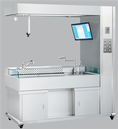


Hey there! As a supplier of Portable Fume Hoods, I often get asked about how often the filters in these handy devices should be replaced. It's a crucial question, and the answer isn't as straightforward as you might think. So, let's dive right in and explore this topic in detail.
First off, let's understand what a Portable Fume Hood is and why filters are so important. A Portable Fume Hood is a self - contained ventilation system designed to capture and remove harmful fumes, vapors, and particulate matter from the air in a laboratory or workspace. The filters play a vital role in this process. They act as a barrier, trapping contaminants before they can be released back into the environment.
Now, the frequency of filter replacement depends on several factors. One of the most significant factors is the type of contaminants you're dealing with. Different chemicals and substances have different properties, and some are more likely to clog or damage the filters than others.
If you're working with volatile organic compounds (VOCs), for example, these can quickly saturate the filters. VOCs are commonly found in solvents, paints, and adhesives. When these substances evaporate, they form vapors that need to be filtered out. In a high - usage environment where VOCs are being used regularly, you might need to replace the filters every few months.
On the other hand, if you're working with less reactive or less concentrated chemicals, the filters can last longer. For instance, if you're just doing some basic chemistry experiments with mild acids and bases, the filters might not get as dirty as quickly. In such cases, you could potentially go six months to a year before needing a replacement.
Another factor to consider is the volume of work being done. If you're running a busy laboratory where the Portable Fume Hood is in constant use, the filters will naturally wear out faster. More air passing through the system means more contaminants being trapped by the filters. So, in a high - throughput lab, you may need to replace the filters more frequently compared to a small - scale operation where the fume hood is used only occasionally.
The quality of the filters also matters. At our company, we offer high - quality filters that are designed to last longer and provide better filtration. These filters are made from advanced materials that can withstand a higher level of contaminants. However, even the best filters will eventually need to be replaced.
Let's talk about some signs that it's time to replace the filters. One obvious sign is a decrease in the airflow. If you notice that the fume hood isn't pulling in air as strongly as it used to, it could be a sign that the filters are clogged. Another sign is an increase in the presence of odors or visible contaminants in the air. If you can smell chemicals or see particles floating around even when the fume hood is running, it's a clear indication that the filters are no longer working effectively.
So, how do you know for sure when it's time to replace the filters? We recommend doing regular inspections. Check the filters visually for signs of dirt, discoloration, or damage. You can also use a simple airflow meter to measure the air velocity. If the airflow is below the recommended level, it's time for a filter change.
Now, let's touch on the different types of filters used in Portable Fume Hoods. There are generally two main types: particulate filters and gas - phase filters. Particulate filters are designed to capture solid and liquid particles, such as dust, pollen, and aerosols. Gas - phase filters, on the other hand, are used to remove gases and vapors.
The replacement schedule for these two types of filters can vary. Particulate filters may need to be replaced more often, especially in environments where there is a lot of dust or particulate matter. Gas - phase filters can last longer, but they still need to be monitored regularly.
We also offer a range of different Portable Fume Hoods, including Chemical Fumb Hood, Chemistry Fume Hood, and Laboratory Fume Hood. Each of these models is designed to meet specific needs, and the filter replacement requirements may vary slightly depending on the model.
To sum it up, there's no one - size - fits - all answer to how often the filters in a Portable Fume Hood should be replaced. It depends on the type of contaminants, the volume of work, and the quality of the filters. However, by doing regular inspections and keeping an eye out for signs of wear and tear, you can ensure that your fume hood is working effectively and keeping your workspace safe.
If you're in the market for a Portable Fume Hood or need to replace your filters, we're here to help. We have a team of experts who can provide you with personalized advice based on your specific needs. Whether you're a small - scale researcher or running a large - scale laboratory, we can offer the right solutions for you. So, don't hesitate to reach out to us for more information and to start a procurement discussion.


References:
- Various industry reports on fume hood maintenance
- Manufacturer's guidelines for Portable Fume Hood filters