


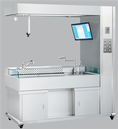


As a supplier of tissue embedders, I often encounter questions from customers regarding the versatility of these essential laboratory instruments. One of the most frequently asked questions is, "Can a tissue embedder be used for embedding tissues in different embedding planes?" In this blog post, I will delve into this topic, exploring the capabilities of tissue embedders and their potential for embedding tissues in various planes.
Understanding Tissue Embedding
Tissue embedding is a crucial step in histological processing, where tissues are infiltrated with a supporting medium, typically paraffin wax, to provide structural integrity and facilitate sectioning. The embedding process involves placing the tissue in a mold filled with molten embedding medium and orienting it in the desired plane. The choice of embedding plane is critical, as it determines the orientation of the tissue sections and can significantly impact the interpretation of histological findings.
The Role of Tissue Embedder
A tissue embedder is a specialized instrument designed to automate and streamline the tissue embedding process. It typically consists of a heating unit, a dispensing system, and a mold holder. The heating unit maintains the embedding medium at a constant temperature, ensuring its fluidity. The dispensing system allows for precise control of the amount of embedding medium dispensed into the mold, while the mold holder securely holds the mold in place during the embedding process.
Can a Tissue Embedder Embed Tissues in Different Embedding Planes?
The short answer is yes. Most modern tissue embedders are designed to accommodate a variety of embedding planes, allowing for flexibility in tissue orientation. This is achieved through the use of adjustable mold holders and dispensing systems, which can be customized to suit the specific requirements of each tissue sample.
Longitudinal Embedding
Longitudinal embedding involves placing the tissue in the mold parallel to its long axis. This embedding plane is commonly used for tissues such as bones, muscles, and nerves, where the orientation of the tissue fibers is important for histological analysis. A tissue embedder can easily be adjusted to achieve longitudinal embedding by aligning the mold holder and dispensing system accordingly.
Transverse Embedding
Transverse embedding, on the other hand, involves placing the tissue in the mold perpendicular to its long axis. This embedding plane is often used for tissues such as organs and blood vessels, where cross-sectional views are required for histological examination. Again, a tissue embedder can be configured to accommodate transverse embedding by adjusting the position of the mold holder and dispensing system.
Oblique Embedding
In some cases, oblique embedding may be necessary to obtain a specific orientation of the tissue. Oblique embedding involves placing the tissue in the mold at an angle to its long axis. This embedding plane can be achieved using a tissue embedder by carefully adjusting the mold holder and dispensing system to ensure the tissue is positioned at the desired angle.
Advantages of Using a Tissue Embedder for Different Embedding Planes
Using a tissue embedder for embedding tissues in different embedding planes offers several advantages:
Precision and Consistency
Tissue embedders provide precise control over the embedding process, ensuring consistent results. This is particularly important when embedding multiple tissue samples or when working with delicate tissues that require careful handling.
Time Efficiency
Automating the embedding process with a tissue embedder significantly reduces the time and effort required for manual embedding. This allows laboratory personnel to focus on other tasks, increasing overall productivity.
Flexibility
The ability to embed tissues in different embedding planes provides greater flexibility in histological analysis. This allows researchers and pathologists to obtain the most relevant information from each tissue sample, leading to more accurate diagnoses and research findings.
Our Tissue Embedder Solutions
At our company, we offer a range of high-quality tissue embedders that are designed to meet the diverse needs of laboratories worldwide. Our Embedding Center Histology and Tissue Embedding Center models are equipped with advanced features that allow for precise and efficient embedding of tissues in different embedding planes.
Our tissue embedders feature adjustable mold holders and dispensing systems, which can be easily customized to suit the specific requirements of each tissue sample. This ensures that tissues can be embedded in the desired plane with maximum accuracy and consistency.
In addition, our paraffin embedding station is designed to provide a stable and controlled environment for the embedding process. This helps to prevent the formation of air bubbles and other artifacts, ensuring high-quality tissue sections for histological analysis.
Contact Us for More Information
If you are interested in learning more about our tissue embedders or would like to discuss your specific requirements, please do not hesitate to contact us. Our team of experts is available to provide you with detailed information and assistance, and we would be happy to arrange a demonstration of our products.
Investing in a high-quality tissue embedder is a smart decision for any laboratory that requires precise and efficient tissue embedding. With our range of advanced tissue embedders, you can be confident that you are getting the best possible solution for your histological needs.


References
- Bancroft, J. D., & Gamble, M. (2008). Theory and Practice of Histological Techniques. Churchill Livingstone.
- Kiernan, J. A. (2008). Histological and Histochemical Methods: Theory and Practice. Oxford University Press.
- Martoja, R., & Martoja, P. (1967). Techniques in Histology. W. H. Freeman and Company.