


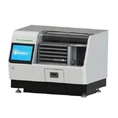


As a dedicated supplier of UV slide printers, I've had numerous inquiries about the printing speed of these remarkable devices. The printing speed of a UV slide printer is a critical factor that greatly impacts productivity, especially in high - volume settings such as medical laboratories, educational institutions, and industrial research facilities.
Understanding the Factors Affecting Printing Speed
The printing speed of a UV slide printer is not a one - size - fits - all metric. It is influenced by a variety of factors, each playing a unique role in determining how quickly the printer can produce high - quality slides.
-
Print Resolution: One of the most significant factors is the print resolution. Higher resolutions require more data to be transferred and processed, which in turn slows down the printing process. For instance, a printer set to a resolution of 300 dpi (dots per inch) will generally print faster than one set to 1200 dpi. The concept is similar to painting a picture; a more detailed painting (higher resolution) takes longer to complete. In a UV slide printer, the printer needs to precisely place more dots of ink on the slide surface at higher resolutions, consuming more time.
-
Slide Size and Format: The size and format of the slides also affect the printing speed. Larger slides naturally require more ink and a longer time to cover the entire surface. A standard microscope slide, which is relatively small, will be printed faster than a larger custom - sized slide. Additionally, if the printer is configured to print multiple slides simultaneously in a multi - slide format, the overall time per slide may be reduced, but the initial setup and processing time for the batch can be longer.
-
Ink Drying Time: UV Slide Printers use UV - curable inks. The time it takes for the ink to dry under the UV light is an important consideration. Different inks have different drying times, and the printer's UV curing system needs to be adjusted accordingly. If the drying time is too short, the ink may not fully cure, leading to smudging or poor adhesion. On the other hand, if the drying time is set too long, it will slow down the overall printing process.
-
Printer Hardware and Software: The internal hardware of the printer, such as the print head, motor, and controller, plays a crucial role in determining the printing speed. A more advanced print head with a higher number of nozzles can deposit ink more quickly. Similarly, a powerful motor can move the print head and the slide platform more rapidly. The software that controls the printer also affects the speed. Well - optimized software can streamline the printing process, reducing idle time and improving overall efficiency.
Typical Printing Speeds
In general, the printing speed of a UV slide printer can vary widely depending on the above - mentioned factors. For a basic UV slide printer operating at a relatively low resolution (e.g., 300 dpi) and printing on standard microscope slides, the printing speed can be around 10 to 20 slides per minute. This speed is suitable for small - scale operations or applications where high - resolution is not a top priority.


For medium - sized laboratories or industrial applications that require a balance between speed and quality, a UV slide printer operating at a resolution of 600 dpi can print approximately 5 to 10 slides per minute. These printers are often equipped with more advanced hardware and software to optimize the printing process.
In high - end UV slide printers designed for large - scale, high - resolution printing, the speed can be as low as 1 to 3 slides per minute when set to a resolution of 1200 dpi or higher. However, these printers are capable of producing extremely detailed and accurate prints, making them ideal for applications such as pathology research and high - precision industrial imaging.
Comparing with Other Slide Printing Technologies
When considering the printing speed of a UV slide printer, it's also important to compare it with other slide printing technologies, such as the Laser Slide Printer. Laser slide printers generally offer faster printing speeds compared to UV slide printers, especially when printing at lower resolutions. The Laser Slide Printing System uses a laser beam to create an image on the slide, which can be a quicker process than depositing ink with a print head. However, UV Slide Printers have their own advantages, such as better color accuracy and the ability to print on a wider range of slide materials.
The Laser Slide Printer is known for its high - speed printing in large - scale production environments. But for applications that require detailed color printing or printing on non - standard slide surfaces, a UV slide printer may be a more suitable choice, despite its relatively slower speed.
Optimizing Printing Speed for Your Needs
As a supplier, I understand that every customer has unique requirements. To optimize the printing speed of your UV slide printer, here are some tips:
- Choose the Right Resolution: If high - resolution is not essential for your application, consider using a lower resolution. This can significantly increase the printing speed without sacrificing too much in terms of quality.
- Batch Printing: Group your slides into batches and print them together. This reduces the time spent on setup and calibration between individual slides.
- Regular Maintenance: Keep your printer well - maintained. Clean the print head regularly to ensure smooth ink flow, and check the UV curing system to ensure it is working efficiently. A well - maintained printer will perform at its best and maintain a consistent printing speed.
- Software Updates: Install the latest software updates for your printer. These updates often include performance improvements and bug fixes that can enhance the printing speed and overall functionality.
Contact Us for Your UV Slide Printer Needs
If you're in the market for a UV slide printer and want to learn more about how our products can meet your specific requirements, we're here to help. Our team of experts can provide detailed information about the printing speed, features, and capabilities of our printers. Whether you're a small - scale laboratory or a large - scale industrial facility, we have the right solution for you. Contact us to start a discussion about your needs and explore the possibilities of our UV slide printers.
References
- "Principles of slide printing Technologies" - A comprehensive guide on different slide printing methods.
- "UV - Curable Inks and Their Applications in slide printing" - Research on the properties and performance of UV - curable inks.
- "Optimizing Printer Performance for High - Volume Slide Printing" - Industry best practices for improving printing speed and quality.