


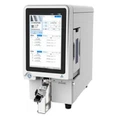
Hey there! As a coverslipper supplier, I've been in the thick of the microscopy and lab equipment scene for quite a while. Today, I want to chat about the alternatives to a coverslipper. You might be wondering why you'd even need an alternative. Well, there are various reasons - cost, specific application requirements, or just wanting to try something new.
Let's start with the basics. A coverslipper is a crucial tool in microscopy. It's used to cover specimens on a microscope slide, protecting them, providing a flat surface for viewing, and helping to keep the specimen in place. But what if you're in a bind and don't have a coverslipper at hand, or you're looking for something different?
Manual Methods
One of the most straightforward alternatives is the manual approach. You can use a pair of fine - tipped forceps to place a coverslip on the specimen. It's a bit of an old - school method, but it can work well, especially for simple specimens. All you need to do is pick up the coverslip with the forceps, hold it at an angle over the specimen, and then slowly lower it onto the slide. This helps to minimize the formation of air bubbles, which can be a real pain in microscopy. However, it requires a steady hand and a bit of practice. If you're not careful, you might end up with a messy slide full of bubbles or a misaligned coverslip.
Another manual option is using a toothpick. Sounds crazy, right? But it can be surprisingly effective. You can use the toothpick to guide the coverslip onto the slide. Place the toothpick at one edge of the coverslip, and then slowly lower the coverslip while using the toothpick as a pivot. This can also help in reducing air bubbles. But again, it's a bit of a finicky process and might not be suitable for large - scale or high - precision work.
DIY Coverslippers
If you're feeling creative, you can make your own coverslippers. For example, you can use thin plastic sheets. You can cut them into the appropriate size and shape using a pair of sharp scissors. Plastic sheets are often readily available and can be a cost - effective alternative. However, they might not have the same optical clarity as glass coverslips. Glass has better refractive properties, which means that specimens viewed through glass coverslips often look sharper and more detailed.
Another DIY option is using clear tape. You can cut a small piece of clear tape and place it over the specimen. It can work in a pinch, especially for very basic observations. But tape has its limitations. It can leave a residue on the slide, and it might not be as durable as a proper coverslip. Also, it doesn't provide the same level of protection as a glass or plastic coverslip.


Alternative Commercial Products
Now, let's talk about some commercial alternatives. There are some products on the market that can serve as substitutes for a traditional coverslipper. For instance, there are liquid coverslip products. These are basically solutions that you can pour over the specimen. Once the liquid dries, it forms a thin, transparent layer that acts like a coverslip. They can be convenient as they eliminate the need to handle a physical coverslip, which can be tricky, especially for small or delicate specimens. However, they might not be suitable for all types of specimens or microscopy techniques.
Some companies also offer disposable slide - coverslip combos. These are pre - assembled units where the coverslip is already attached to the slide. They're great for quick and easy use, especially in high - throughput labs. But they can be more expensive than traditional coverslippers, and you might end up with a lot of waste.
Comparing with Our Glass and Automated Coverslippers
At this point, I'd like to mention our Glass Coverslipper. Our glass coverslippers are made from high - quality glass, which provides excellent optical clarity. They're carefully manufactured to ensure a uniform thickness, which is crucial for accurate microscopy. Whether you're observing biological specimens or conducting material science research, our glass coverslippers can give you the best viewing experience.
And then there's our Automated Glass Coverslipper. This is a game - changer for labs that do a lot of slide preparation. The automated system can place coverslips quickly and accurately, reducing the risk of human error. It can handle a large number of slides in a short amount of time, which is great for high - volume work. It also ensures consistent results, so you don't have to worry about variations in coverslip placement from one slide to another.
If you're still on the fence about whether to choose an alternative or our coverslippers, consider your specific needs. If you're doing a one - off experiment and just need a quick fix, a manual or DIY method might work. But if you're running a professional lab with high - quality standards and a lot of work to do, our glass and automated coverslippers are definitely worth considering.
Why Choose Our Coverslippers
Our coverslippers are designed with the user in mind. We understand the importance of quality and precision in microscopy. Our glass coverslippers are free from defects like scratches and bubbles, which can interfere with your observations. And our automated system is easy to operate, even for those who aren't tech - savvy.
We also offer excellent customer support. If you have any questions about our products, or if you run into any issues, our team is always ready to help. We want to make sure that you have the best experience possible with our coverslippers.
Contact Us for Purchase
If you're interested in learning more about our coverslippers or want to place an order, don't hesitate to reach out. We're always happy to have a chat about your specific requirements and how our products can meet them. Whether you're a small research lab or a large educational institution, we have the right coverslipper solution for you.
References
- Murphy, D. B. (2001). Fundamentals of light microscopy and electronic imaging. Wiley - Liss.
- Pawley, J. (Ed.). (2006). Handbook of biological confocal microscopy. Springer Science & Business Media.